
The open access models for books resemble those in journal publishing, but their adoption has had varied success, due to the diverse and fragmented landscape of book publishers and the lack of systemically integrated costing solutions in policies.
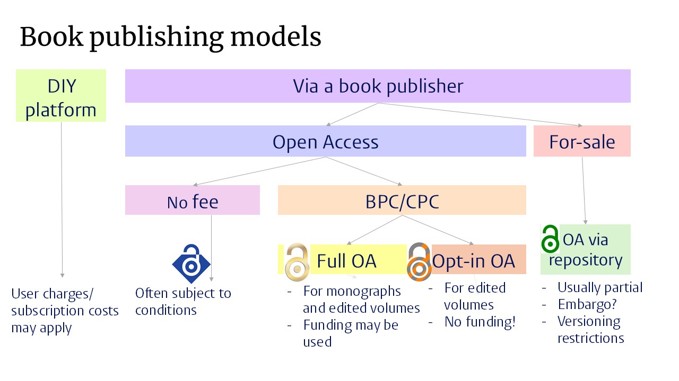
Fee-based OA via the publisher
The most-often used route for publishing a book in open access is through an author/editor fee: Book Processing Charge (BPC) for monographs and edited volumes, or Chapter Processing Charges (CPC) for edited volumes; the so-called ‘Gold’ model. Depending on the publisher and the specifics of the book, BPCs may vary widely: fees between €5,000 and €18,000 are most common. CPCs vary as well, typically between €500 and €2000.
Reliable book publishers that offer fee-based open access can be discovered through the Directory of Open Access Books (DOAB), which currently indexes hundreds of publishers.
- Some publishers accept opt-in Open Access for edited volumes, charging CPCs to authors if they wish. This model effectively results in hybrid open access book publications, where parts become freely available online and others remain behind a paywall;
- Some publishers offer to reduce the BPC/CPC in exchange for imposing an embargo period in which they offer the book for-sale, before opening the contents up.
These two business models can be criticized for ‘double-dipping’ (i.e. charging both sides of the scholarly communication cycle), and are generally not endorsed by research funders.
- Some publishers offer BPC/CPC-based open access online, and sell print copies of the book alongside.
This business model is generally accepted by funders and in open access policies, because the contents of the work are fully open, and the per-copy costs for the production and dissemination of paper books are evident. Charging the reader for a tangible product is not considered unreasonable.
No-fee open access via the publisher
Next to open access based on author-side fees, some publishers operate on business models that do not charge authors or readers and make all content immediately available with an open license; this model is known as ‘Diamond’. They depend on institutional subsidies, library memberships, collective funding (for instance from learned societies) or voluntary contributions, and may retrieve additional income from the sale of print books.
It is not always easy to discover no-fee open access book publishers, as there are no indexing services that highlight them through filters.The following manually curated list is the most complete so far: Hopkins, K. (2026). ‘Where can I publish a book open access without (necessarily) paying a fee? A list of Diamond open access options’, Zenodo. https://doi.org/10.5281/zenodo.20287653
- Some publishers offer a version of the book (usually HTML) for free, read-only access, but charge readers for other file formats like ePub and PDF.
Publishers dub this model ‘freemium’, as basic content and services are free, but premium services and ease of access cost the reader or reader-side institution. If the work is made available with an open license, it is generally considered open access.
Open access via self-archiving in a repository
For books that are published in a traditional model that charges readers to access the content, the author may be equipped with options to deposit an open version of the work; so-called ‘Green’ open access. The specifics of these self-archiving permissions are detailed in the publishing agreement, and usually contain limitations on four aspects:
- Partial open access: most publishers restrict the amount of content that the author can freely share, typically to 10-20% of the work’s extent (measured in numbers of pages);
- Embargos: most publishers state that the work can only be opened up with a delay following the original publication; typically 12 months, although embargos of up to 36 months are not unheard of;
- License specifications: many publishers prescribe the license that authors must use for the self-archived copy of the work, although it may (or may not) differ from the (copyrighted) published version;
- Version: many publishers prohibit sharing of the final publication (Version of Record) and instead allow authors to share the peer-review approved manuscript (Postprint/ Author’s Manuscript) and/or the manuscript as it was originally submitted (Preprint version). Some publishers include separate instructions for sharing different versions. Yet note that, in contrast with journal articles, preprint sharing before having been accepted for publication is almost never allowed for books!
These clauses merit careful consideration of authors and editors, before signing a book publication agreement. Self-archiving options can be subject to negotiations by authors and editors before signing the contract.
Note that individual chapters in edited volumes qualify as ‘short scholarly works’ and can therefore be made available in the author’s institutional repository after a six-month embargo. This ‘Taverne route’ is governed in the Dutch Copyright Act (art. 25fa), which supersedes any publishing agreements between authors/editors and publishers.
If one individual author contributed more than one chapter to an edited volume, the general recommendation is to deposit one chapter via the Taverne route. Authors are also recommended to get in touch with their university’s open access support for specific advice.
References
E. Ferwerda, F. Pinter, & N. Stern, A Landscape Study on Open Access and Monographs: Policies, Funding and Publishing in Eight European Countries, 2017 on Zenodo. https://doi.org/10.5281/zenodo.815932
F. Pinter, 'Why Book Processing Charges (BPCs) Vary So Much', Journal of Electronic Publishing 21.1 (2018). https://doi.org/10.3998/3336451.0021.101